

Published
12 min read
What Does It Mean to Get Cited by ChatGPT?
Getting cited by ChatGPT means ChatGPT names, recommends, or links to your brand as a source when a buyer asks about your category. Crawler access makes you eligible. In our view, specific facts and confirmation from other trusted sites improve your odds.
A citation can take a few forms:
- Brand mention: ChatGPT names your company in its answer.
- Shortlist spot: ChatGPT includes you in a list of recommended vendors.
- Page reference: ChatGPT pulls a fact, definition, or step from your content.
- Source link: ChatGPT shows a clickable link to your page next to its answer.
Success means showing up when buyers ask category questions, like "Who sells 311 software to city governments?" Ranking for your own brand name is not enough.
This shift is real for business buyers in general. Per Forrester buyer AI research, "twice as many buyers named generative AI or conversational search as a more meaningful or important source of information than any other source." That survey covered business buyers broadly, not government buyers specifically.
We haven't found a public study on how SLED buyers use AI. Still, state procurement guidance, such as Oregon's procurement manual, tells buyers to research the market with common search engines before a solicitation.
The manual says, "The procurement professional can assess the current state of a given market for the needed product or service through a desktop review using common search engines." That guidance covers Oregon state agencies only. In our experience, though, early research is a core part of selling to state and local government.
ChatGPT SEO vs. Traditional SEO
ChatGPT SEO is the practice of making your content easy for ChatGPT to find, trust, and quote. You may also hear it called generative engine optimization (GEO), which covers AI tools beyond ChatGPT.
Traditional SEO helps you rank in a list of Google links. ChatGPT SEO helps you appear inside a written answer. Here's how they compare:
| Factor | Traditional SEO | ChatGPT SEO |
|---|---|---|
| What the buyer sees | A ranked list of blue links | One synthesized answer with a few cited sources |
| Main signals | Backlinks, keywords, page experience | Not published; in our view, clear answers, specific claims, third-party corroboration |
| Main metric | Rankings, clicks, and traffic | Share of Answer (how often you appear in answers) |
| Crawler to allow | Googlebot and Bingbot | OAI-SearchBot |
| Shared foundations | Crawlable pages, clean structure, fast load | Crawlable pages, clean structure, fast load |
The foundations overlap, so a well-built site already covers much of the groundwork.
Why ChatGPT Cites Some Sources and Ignores Others
OpenAI doesn't publish its ranking factors. Research on AI answer engines does point to patterns worth following, though.
The strongest evidence comes from a 2024 study by Aggarwal and colleagues, presented at the KDD conference. Per the Princeton GEO research paper, "including citations, quotations from relevant sources, and statistics can significantly boost source visibility, with an increase of over 40% across various queries." The paper's abstract describes gains of up to 40% in a 2024 test engine.
Keep the limits in mind. The researchers tested a simulated engine built on GPT-3.5, plus Perplexity, not ChatGPT search itself.
The same study found two more useful results:
- Keyword stuffing failed: Cramming in keywords gave little to no improvement in the test engine.
- Statistics helped government topics: The "Law & Government" category gained strongly from added statistics, though the authors called their category labels noisy.
In our view, sources that get cited tend to share five traits. They give direct answers, use concrete data, have clear structure, are confirmed by other sites, and describe the company consistently.
OpenAI doesn't publish its ranking factors, but Microsoft's guidance on AI search answers overlaps on direct answers, specific data, and structure. Microsoft says "success starts with content that is fresh, authoritative, structured, and semantically clear." That guidance describes Bing and Copilot, not ChatGPT.
Microsoft's guidance doesn't cover third-party corroboration or consistency, so treat those two traits as our view.
How to Get Cited by ChatGPT in 6 Steps
No tactic guarantees a spot in ChatGPT answers. You can, however, make your company easy to find, easy to quote, and easy to trust.
Work through these steps in order: research first, then technical basics, then content and proof.
1 Step 1: Map the Prompts Your Buyers Actually Ask
A prompt is the question a buyer types into ChatGPT. Start by listing 20 to 30 prompts your buyers might use at each stage of a purchase.
- Category prompts: "Best permitting software for mid-size counties."
- Contract prompts: "Which body camera vendors are on our state contract vehicle?"
- Problem prompts: "How can a city council speed up public records requests?"
- Comparison prompts: "Compare [your company] and [competitor] for school district transportation."
A state contract vehicle is a pre-approved agreement that lets agencies buy without running a full bid. Prompts tied to RFP stages matter too, since buyers often research before and during the work of answering government RFPs.
Next, run each prompt in ChatGPT and record a baseline. Note whether you appear, which competitors show up, which sources get cited, and whether the facts about you are accurate.
2 Step 2: Let OpenAI's Crawler In
A crawler is a bot that reads web pages. OAI-SearchBot is the crawler that ChatGPT search uses to find content.
This matters more than any content tactic. Per OpenAI's crawler documentation, "Sites that are opted out of OAI-SearchBot will not be shown in ChatGPT search answers, though can still appear as navigational links."
Take these actions with your web team:
- Check robots.txt: This file tells bots what they can read, so make sure it allows OAI-SearchBot.
- Check your CDN: Your content delivery network or host must allow OpenAI's published crawler IP addresses.
- Separate GPTBot: GPTBot collects training data, and you can block it while still allowing OAI-SearchBot.
- Wait a day: OpenAI says robots.txt changes can take about 24 hours to take effect.
Set expectations with your team, too. Access makes you eligible, and OpenAI's ChatGPT search help says it plainly: "Placement is not guaranteed."
3 Step 3: Publish Specific, Citable Content
In our view, content that answers a question clearly and backs it up gives ChatGPT something worth quoting. Vague lines like "a powerful platform for modern agencies" give it nothing to quote.
Public-sector specifics make good candidates for citation. Think step-by-step procurement guides, budget calendar explainers, and checklists for joining a procurement cooperative, a group of agencies that share contracts to buy together.
- Lead with the answer: Put the direct answer in the first sentence under each heading.
- Define your terms: Spell out acronyms, such as RFQ (request for quote), the first time you use them.
- Use tables and lists: Microsoft advises that "Bulleted lists, numbered steps, and comparison tables break complex details into clean, reusable segments."
- Keep schema basic: Schema is code that labels your content, so add Organization, Article, and FAQPage types as hygiene, not a citation lever.
- Cite your sources: Name and link the agency, study, or report behind every number.
Don't expect schema to win citations. Per Google's guide to generative AI search, "Structured data isn't required for generative AI search, and there's no special schema.org markup you need to add." That guide covers Google's AI features, and OpenAI hasn't said how schema affects ChatGPT.
We'd argue original insight is the most citable of all. A clear explainer on public-sector buying signals, such as council votes and approved bonds, is the kind of page AI can reference.
4 Step 4: Earn Third-Party Corroboration
Corroboration means other trusted sites confirm what you say about yourself. In our view, buyers look for it, because many double-check AI answers.
Per the TrustRadius 2026 buyer report, "63% of buyers used AI during their purchase journey, yet 94% fact-check its responses at least some of the time." TrustRadius says its research indicates that "AI-generated recommendations are heavily influenced by trusted third-party content." Its survey covered technology buyers in general, not SLED.
In our experience working with public-sector vendors, the most trusted voices in SLED are often peers. Aim for mentions in places like these:
- Associations: State associations of counties, municipal leagues, and school business official groups.
- Cooperative listings: Your vendor page on procurement cooperative sites where agencies shop.
- Trade publications: GovTech and education outlets that agency leaders read.
- Partner pages: Integration and reseller partners that list your company.
- Review sites: Honest reviews from real agency customers.
- Podcasts and webinars: Episodes where you teach, not pitch.
Treat this as one channel within a broader plan, like the one in our EdTech marketing strategy guide.
5 Step 5: Keep Your Entity Information Consistent
An entity is how AI understands your company: who you are, what you sell, and who you serve. In our view, mixed signals make you harder to recommend.
Audit these facts across your website, LinkedIn, directories, and review profiles:
- Company name: Use one exact name everywhere.
- Category: Describe what you sell in the same words each time.
- Audiences served: List the same agency types, such as counties, cities, and school districts.
- Contract vehicles: Name every state contract and cooperative agreement you hold.
- Certifications: List security or compliance credentials your buyers require.
This ties to E-E-A-T, Google's term for experience, expertise, authoritativeness, and trustworthiness. We believe consistent, verifiable facts help both people and AI trust you.
6 Step 6: Measure Share of Answer
Share of Answer is the percentage of tracked prompts where ChatGPT mentions or cites your brand. If you appear in 9 of 30 prompts, your Share of Answer is 30%.
Re-run your prompt list monthly and track these metrics:
- Brand mentions: How often ChatGPT names you.
- Competitor mentions: Who shows up instead of you.
- Cited sources: Which sites ChatGPT links when it discusses your category.
- Referral traffic: Visits from chatgpt.com in your web analytics.
Other tools can help. Microsoft's AI Performance announcement introduced a Bing Webmaster Tools report on citations in Microsoft's AI answers. It covers Microsoft Copilot, AI summaries in Bing, and select partner integrations.
Feed this data into your RevOps (revenue operations) system so AI visibility sits next to pipeline data. That's a core part of GTM Engineering for public sector.
Common Mistakes That Keep Vendors Invisible to ChatGPT
Shortcuts are risky in any market. In our experience, they're worse in SLED, because agencies talk to each other and a bad impression can travel.
Avoid these common mistakes:
- Keyword stuffing: Research showed little to no gain in a test engine, and in our view it reads poorly to buyers.
- Thin AI content: Generic articles offer little new worth quoting.
- Unsupported claims: Big promises without sources fail the buyer's fact-check.
- Fake reviews: In our experience, one exposed review can cost you trust across a whole state.
- Contradictory listings: Old names or wrong contract details can confuse AI and buyers.
- Blocked crawlers: A robots.txt or CDN rule that blocks OAI-SearchBot removes you from answers.
Where ChatGPT SEO Fits in Your Go-to-Market
ChatGPT SEO is an inbound lever. It helps buyers find you while they research. It works best alongside outbound that is timed to real buying signals, as we explain in our guide to inbound vs. outbound sales.
In a finite market, you can count every agency that could buy. That means every touch should be scored, not guessed.
Here's how the system fits together:
- Start with fit: Define your ICP (ideal customer profile), such as counties with 100,000 to 500,000 residents.
- Add public-sector signal: Track council votes, open RFPs, approved bonds, and budget allocations through Starbridge.
- Enrich with CRM context: RevOps adds deal history, past contacts, and AI visibility data.
- Score 50/50: Weight fit and signal equally to rank which agencies are in-market now.
- Act on the score: Use it to drive messaging, targeting, and when your SDR calls or emails.
Budget calendars and procurement windows are signals too. When a county approves its fiscal-year budget, your outreach and your ChatGPT presence should both be ready.
In our experience, public-sector buyers reward domain expertise, buyer intelligence, and timing over raw volume. ChatGPT visibility can help them recognize your name when your team reaches out.
Frequently Asked Questions About ChatGPT SEO
How Long Does It Take to Get Cited by ChatGPT?
OpenAI says crawler access changes can take about 24 hours, but earning citations takes longer and has no guaranteed timeline. Plan to track progress monthly over at least a few months.
Do I Need Third-Party Mentions to Get Cited by ChatGPT?
They aren't strictly required, but we believe they help buyers and AI confirm your claims. In our experience working with public-sector vendors, mentions from associations, cooperatives, and peer agencies carry extra weight in SLED.
What Schema Markup Helps Get Content Cited by ChatGPT?
Google's guide says no special schema.org markup is needed for its generative AI search, and OpenAI hasn't named any for ChatGPT. Treat Organization, Article, and FAQPage schema as basic hygiene, not a citation lever.
Can I Pay to Rank in ChatGPT?
OpenAI doesn't describe any way to buy a citation in ChatGPT search answers, and it says placement is not guaranteed. Your best path is crawler access, citable content, and third-party proof.
How Do I Know If ChatGPT Mentions My Brand?
Run a fixed list of buyer prompts in ChatGPT each month and record mentions, competitors, and cited sources. Also check your analytics for referral visits from chatgpt.com.
Blogs

Explore Our Articles
Stay ahead with cutting-edge strategies and insights from industry experts
 GEO
14 min read
What Is an AI Visibility Audit? A GEO Audit Guide for SLED Vendors
An AI visibility audit is a structured check of whether AI tools mention, cite, and accurately describe your company when buyers ask questions. It’s also called an AI search audit or GEO audit, and it covers ChatGPT, Gemini, Perplexity, Claude, and Google AI Overviews.
Read Article
 GEO
15 min read
Generative Engine Optimization Services: A GEO for B2B Guide for SLED and Education Vendors
Your next buyer may meet you inside a chatbot before they ever visit your website. A Curriculum Director can ask ChatGPT for permitting software vendors and get a shortlist in seconds. Generative engine optimization services aim to put your company on that list. This guide explains GEO for B2B in plain terms, with examples from […]
Read Article
 GEO
13 min read
What Is Generative Engine Optimization (GEO)? A Plain-English Guide for Public-Sector Vendors
Generative engine optimization (GEO) is the practice of shaping your content so AI tools find it, trust it, and cite it in their answers. Those tools include ChatGPT, Perplexity, Gemini, and Google AI Overviews. SEO (search engine optimization) aims for a ranked link in search results. GEO aims for a mention or citation inside the […]
Read Article
 GEO
4 min read
Introducing AI Search: We Now Get You Cited, Not Just Ranked
Your buyers stopped running ten Google searches. Now they ask ChatGPT, Perplexity, Gemini, Claude, or Google AI Overviews one question, like “which vendors provide case management for county governments,” and get back a shortlist of five names. If you’re not on that list, the research is over before you knew it started. That’s why we […]
Read Article
15 min read
Best SDR and Lead Generation Agencies for SLED in 2026: A Buyer’s Guide to Lead Generation for SLED
Lead generation for SLED is a different job than commercial B2B prospecting. SLED stands for state, local, and education buyers, and each of them buys on public rules and public calendars. This guide compares the agencies worth a look in 2026 and shows you how to vet them.
Read Article
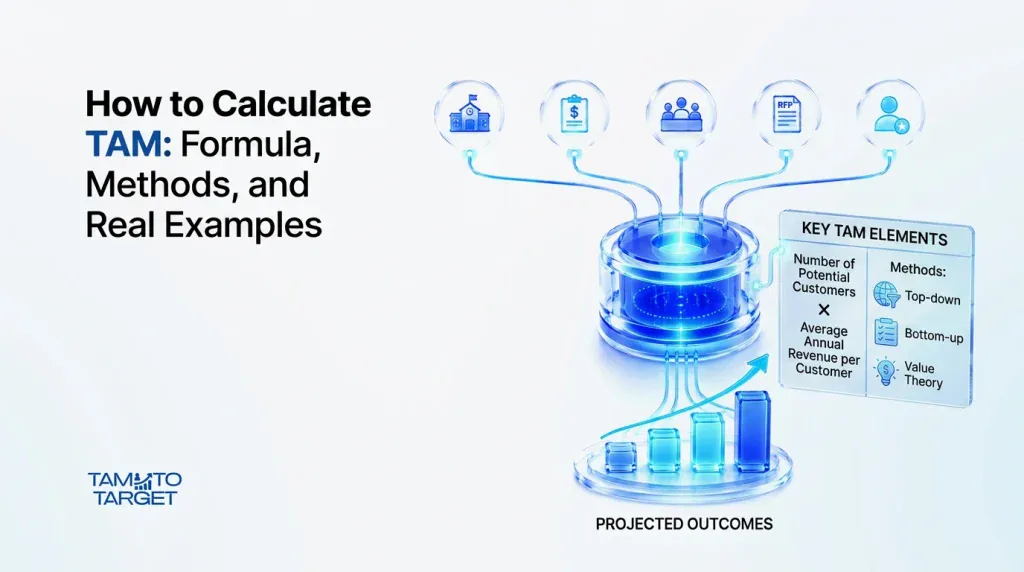
11 min read
How to Calculate TAM: Formula, Methods, and Real Examples
If you need a market number for a board deck or a pipeline plan, learning how to calculate TAM is the place to start. The math is simpler than it looks. This guide covers the formula, the three main methods, and worked examples from K-12, higher ed, and local government.
Read Article
Ready to build pipeline in the gov + edu market?
Book a call and we'll show you exactly how we get your motion live and generating qualified meetings.
Book a Call