

Published
11 min read
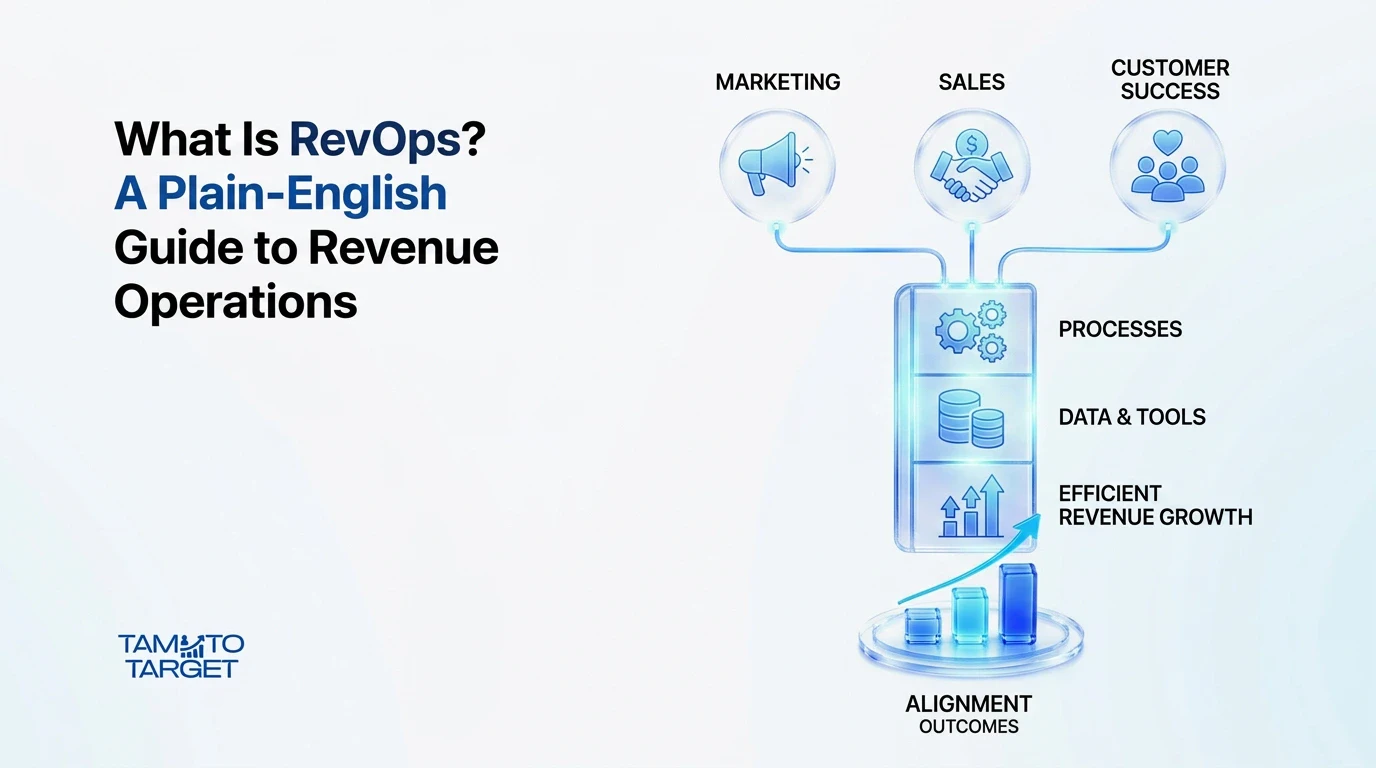
What Is RevOps?
RevOps (short for revenue operations) is the function that aligns sales, marketing, and customer success around one set of data, processes, tools, and revenue goals. Instead of each team running its own playbook, everyone works from the same plan and the same numbers.
Boston Consulting Group (BCG) describes RevOps as centralizing the operations teams from marketing, sales, and customer success. In BCG's RevOps research, the firm says RevOps "has emerged as a high-impact way to accelerate revenue growth and go-to-market (GTM) operations efficiency." Go-to-market simply means how you find, win, and keep customers.
So what is RevOps in business terms? Think of it as a system more than a department. It connects your people, data, and tools into one go-to-market operating system, so revenue stops leaking between teams.
1 RevOps Is an Operating Model, Not Just a Team
An operating model is the way work gets done: who does what, with which tools, and how you measure it. Per Forrester's RevOps operating model, "revenue leaders increasingly recognize the need to move away from thinking in terms of org charts and job titles."
That's good news for growth-stage companies. You don't need a five-person department to do RevOps well.
A $5M company can start with one owner and a clean CRM. CRM stands for customer relationship management, the system where you track every contact and deal. Add shared definitions that every team agrees on, and you're already doing RevOps.
Why RevOps Matters for B2B Teams
Most revenue problems aren't effort problems. They're coordination problems. BCG notes that go-to-market teams are often "run in silos with misaligned incentives," which leads to messy data, duplicate reports, and broken handoffs.
A silo is a team that works in isolation from the others. BCG adds that siloed teams struggle with data consistency and reliability. In one Salesforce survey, republished in the Salesforce State of Sales report, only 35% of sales professionals completely trusted the accuracy of their organization's data.
When teams do align, the upside can be big. In 2020, BCG said top B2B technology companies, led by software-as-a-service (SaaS) providers, reported 100% to 200% increases in digital marketing ROI. Those companies also reported 10% to 20% gains in sales productivity and 30% lower go-to-market expenses.
Keep the context in mind. These were self-reported results from top tech firms in 2020, not a controlled study of companies your size.
For companies selling into K-12, Higher Ed, or state and local government, the stakes are higher. In a finite market, you can count every possible buyer, and superintendents and CIOs talk to each other. A duplicate email or a dropped handoff can cost you your reputation across an entire district.
The 4 Pillars of Revenue Operations
So what does revenue operations do day to day? We break RevOps work into four pillars: operations, enablement, insights, and tools and technology.
Each pillar supports the others. A weak spot in one shows up in all four.
1 Operations
The operations pillar designs how revenue work flows. It covers lead routing, handoffs between teams, account planning, and forecasting, which means predicting how much revenue will close and when.
In small markets, account-based planning beats carving the map into territories. When you only have a few thousand possible buyers, you plan around specific accounts and their buying signals. Spraying a territory with generic outreach burns through your market fast.
2 Enablement
Enablement makes sure people can actually follow the process. It includes rep training, sales playbooks, call guides, and the content reps share with buyers.
A great process on paper means nothing if reps don't know it exists. Good enablement turns your RevOps design into daily habits.
3 Insights
The insights pillar turns raw data into decisions. RevOps builds the reports, dashboards, and forecasts that every team relies on. Forrester advises that executive dashboards "should focus on impact, not activity."
TAM stands for total addressable market, or every possible customer you could sell to. In a finite TAM, the most useful insight is knowing which accounts deserve attention first. That's why we help clients build an account scoring model that ranks every account by fit and revenue potential.
4 Tools and Technology
This pillar manages your tech stack, which is the set of software your revenue teams use. The CRM should be your single source of truth, with other tools feeding it clean data automatically.
Many growing teams have the opposite problem: too many tools that don't talk to each other. RevOps cuts that tool sprawl by integrating your tech stack so data flows to one place.
Here's what that looks like in practice. One K-12 student services company we worked with saved 100+ hours of RevOps and marketing time through CRM optimization and automation. It also saw a 400% increase in qualified lead volume.
RevOps vs. Sales Operations
Sales operations (sales ops) supports the sales team only. It handles quotas, territories, and sales tools. Marketing operations (marketing ops) does the same for marketing, running campaign tools, lead scoring, and reporting.
In our view, RevOps sits above both and adds customer success, which matches BCG's description of centralizing operations teams from all three functions. Its job is to make the whole revenue engine work as one, from first touch to renewal.
| Area | Sales Ops | Marketing Ops | RevOps |
|---|---|---|---|
| Scope | Sales team | Marketing team | Sales, marketing, and customer success |
| Main goal | Rep productivity and quota attainment | Lead volume and campaign results | Predictable, efficient revenue growth |
| Owns | Territories, quotas, sales tools | Campaign tools, lead scoring, attribution | Shared data, processes, tech stack, and handoffs |
| Typical leader | VP of Sales | VP of Marketing or CMO | Often the CRO or CEO |
| Key metrics | Win rate, quota attainment | Leads generated, cost per lead | Pipeline velocity, forecast accuracy, retention |
Want a quick test? If sales and marketing report different numbers for the same pipeline, nobody owns the full picture yet.
What Does a RevOps Team Do?
A RevOps team owns the systems behind revenue, so sellers can focus on selling. Common RevOps responsibilities include:
- Process design: Map how leads move from marketing to sales to customer success.
- Data quality: Keep CRM records clean, complete, and free of duplicates.
- Reporting: Build dashboards and forecasts that leaders can trust.
- Tech stack management: Choose, connect, and maintain your revenue tools.
- Planning: Set targets, account assignments, and capacity plans with leadership.
- Enablement support: Give reps the training and playbooks they need.
In the companies we work with, RevOps often reports to the CRO (chief revenue officer) or the CEO. That keeps it neutral, so it works for the whole revenue team instead of one department.
At $2M-$50M in revenue, a full-time RevOps team often isn't realistic yet. A fractional RevOps model gives you senior RevOps help part time, without the cost of a full in-house team.
Key RevOps Metrics to Track
RevOps metrics tell you whether your revenue engine is healthy. BCG ties RevOps alignment to metrics like LTV/CAC, customer satisfaction, and pipeline velocity.
| Metric | What It Measures | Why It Matters |
|---|---|---|
| Pipeline velocity | How fast deals move through the pipeline and turn into revenue | Shows whether pipeline is flowing or stuck |
| Win rate | Share of opportunities that close as won | Reveals targeting and sales quality |
| Sales cycle length | Average days from first meeting to closed deal | Helps you plan and forecast |
| Customer acquisition cost (CAC) | Total sales and marketing spend to win one customer | Shows how efficiently you grow |
| LTV/CAC ratio | Customer lifetime value compared with acquisition cost | Tells you if growth is profitable |
| Forecast accuracy | How close forecasts land to actual results | Builds trust with leadership and the board |
| Churn and net revenue retention (NRR) | Revenue lost versus revenue kept and expanded from current customers | Shows how well you keep and grow accounts |
Long sales cycles add a twist. If a deal takes six months or more, closed revenue is too slow to steer by.
Track leading indicators too. These are early signals that predict future results, like engaged accounts, meetings held, and deals moving stages. Our guide to metrics for long sales cycles covers which ones to watch.
Signs Your Company Needs RevOps
Not sure if it's time? Watch for these warning signs:
- Tool sprawl: Your team pays for tools that overlap or don't connect.
- Conflicting reports: Sales and marketing bring different numbers to the same meeting.
- Lost handoffs: Leads go cold between marketing, sales, and customer success.
- Unpredictable forecasts: You can't say with confidence what will close this quarter.
- Manual busywork: Reps spend hours updating spreadsheets instead of selling.
If two or more of these sound familiar, it's time to make RevOps a priority.
How to Build a RevOps Strategy
A RevOps strategy doesn't start with a reorg. BCG warns that "org restructuring alone is not a silver bullet," because processes and tools are where results happen.
Here's a practical six-step path for growth-stage teams.
1 Audit Your Current State
Start with a diagnostic. List your tools, map how leads and deals move today, and note where data breaks or handoffs stall.
2 Map Your Market
In finite markets, this step sets up everything else. TAM mapping and enrichment means building a list of every possible account and filling in the data you need to reach them.
For example, we mapped one K-12 social-emotional learning (SEL) company's full US TAM of 13,000+ schools. We hit 99% coverage in three weeks, and every school was scored for revenue potential.
3 Set Shared Goals and KPIs
Agree on one set of definitions, like what counts as a qualified lead. KPIs (key performance indicators) only work when every team measures them the same way.
4 Clean and Connect Your Stack
Fix duplicate records, fill in missing fields, and connect your tools to the CRM. Cut any tool that doesn't earn its keep.
One K-12 nonprofit we worked with got a full CRM buildout with custom objects, automated workflows, and pipeline dashboards. It went from about one qualified meeting per quarter to 15+ in 45 days.
5 Standardize Handoffs
Write down exactly when and how a lead passes from marketing to sales, and from sales to customer success. Include the details that must travel with it.
6 Pilot, Then Scale
Test changes with one team or segment first. Forrester suggests capturing pilot results carefully "to prove the case for a wider adoption." Once it works, roll it out everywhere.
Does RevOps Pay Well?
Common RevOps roles include RevOps analyst, RevOps manager, director of revenue operations, and VP of revenue operations. In our experience, many people move into these jobs from sales ops, marketing ops, or CRM administration.
There's no official government salary data for RevOps. The Bureau of Labor Statistics (BLS) does not track RevOps as its own occupation.
The closest related role is sales manager, which works only as a rough proxy. Per BLS sales manager pay data, the median annual wage for sales managers was $148,270 in May 2025. That figure includes commissions and bonuses, so RevOps pay may look different.
Frequently Asked Questions About RevOps
Here are quick answers to the questions we hear most from sales leaders who are new to RevOps.
What Does RevOps Stand For?
RevOps stands for revenue operations, the function that aligns sales, marketing, and customer success around shared data, processes, tools, and goals.
Is RevOps the Same as Sales Ops?
Not quite. Sales ops supports the sales team, while RevOps, as BCG describes it, brings together operations across sales, marketing, and customer success.
When Should a Company Invest in RevOps?
Invest when you have product-market fit but see inconsistent results, conflicting reports, or leads lost between teams. In our experience, many growth-stage B2B companies hit this point as they add reps and tools.
Can a Small Company Do RevOps Without a Full Team?
Yes. Start with one owner, a clean CRM, and shared definitions, or bring in fractional RevOps support until a full-time hire makes sense.
Getting Started With RevOps
So, what is RevOps? It's the system that keeps sales, marketing, and customer success working from the same data, process, and goals. Start small: audit, map your market, clean your stack, and pilot.
In finite markets, getting this right protects your reputation while you grow pipeline. Our modern GTM RevOps services build and run the system with you, tailored to K-12, Higher Ed, and state and local government.
Schedule time with our team and we'll help you find your next $500k in pipeline.
Blogs

Explore Our Articles
Stay ahead with cutting-edge strategies and insights from industry experts
15 min read
Best SDR and Lead Generation Agencies for SLED in 2026: A Buyer’s Guide to Lead Generation for SLED
Lead generation for SLED is a different job than commercial B2B prospecting. SLED stands for state, local, and education buyers, and each of them buys on public rules and public calendars. This guide compares the agencies worth a look in 2026 and shows you how to vet them.
Read Article
11 min read
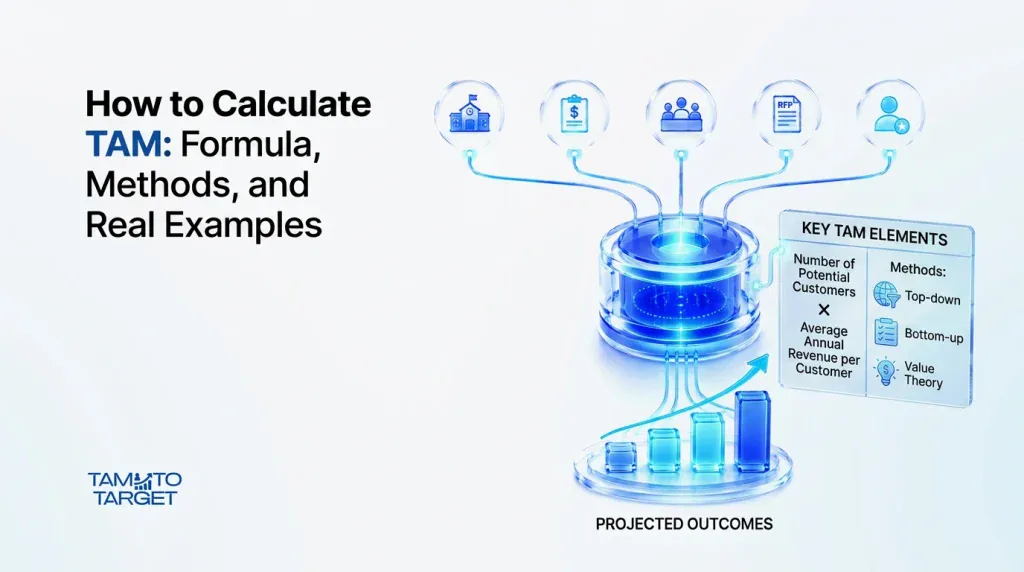
How to Calculate TAM: Formula, Methods, and Real Examples
If you need a market number for a board deck or a pipeline plan, learning how to calculate TAM is the place to start. The math is simpler than it looks. This guide covers the formula, the three main methods, and worked examples from K-12, higher ed, and local government.
Read Article
13 min read
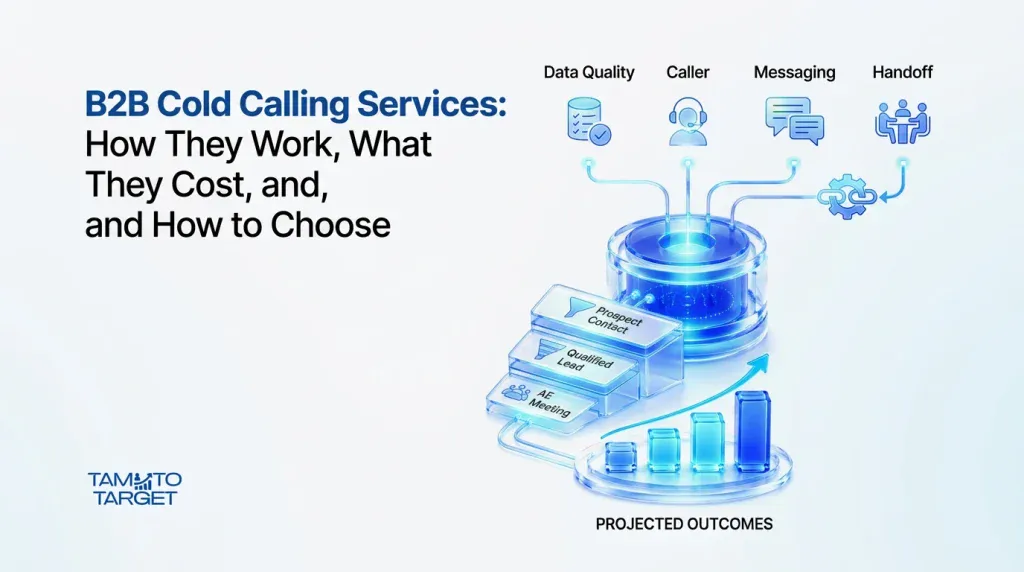
B2B Cold Calling Services: How They Work, What They Cost, and How to Choose
Your AEs should spend their time closing deals. Too often, they spend it hunting for the next meeting instead. B2B cold calling services fix that by handing first conversations to a trained outside team. This guide covers how these services work, what they cost, and how to pick a partner. You’ll also get benchmarks from […]
Read Article
12 min read
HubSpot Deal Stages: How to Set Up, Customize, and Forecast With Them
Your pipeline report says you’ll hit the number. Then half your late-stage deals slip into next quarter. Often, the cause is how your HubSpot deal stages are defined. This guide explains what deal stages are, how HubSpot’s defaults work, and how to customize them. You’ll also learn how to set entry and exit criteria, automate […]
Read Article
17 min read
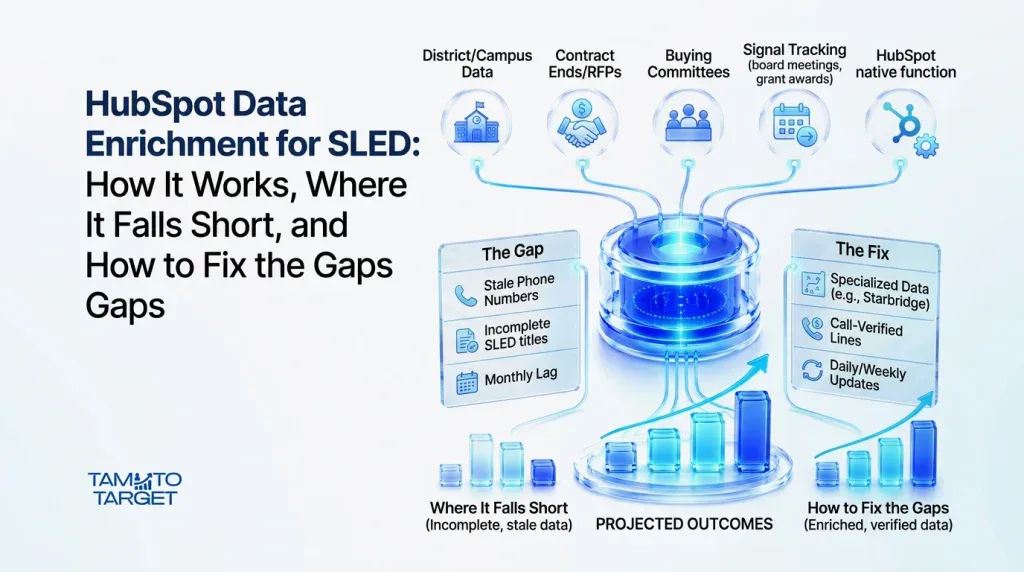
HubSpot Data Enrichment for SLED: How It Works, Where It Falls Short, and How to Fix the Gaps
Most HubSpot records start thin. A form fill gives you a name and an email, and maybe a job title if you asked for one. HubSpot data enrichment fills in the rest, so your team isn’t guessing who they’re talking to. Thin records are common. In July 2026, Validity surveyed 500 B2B and B2C marketing […]
Read Article

10 min read
What Is B2G Sales? A Beginner’s Guide to Business to Government Sales
If your team sells to schools, cities, or state agencies, you’re already doing B2G sales, even if nobody calls it that. Business to government sales follows its own rules, calendars, and buying habits. This guide covers what B2G means, how it differs from B2B and B2C, and how public agencies actually buy. You’ll also learn […]
Read Article
Ready to build pipeline in the gov + edu market?
Book a call and we'll show you exactly how we get your motion live and generating qualified meetings.
Book a Call