

Published
13 min read
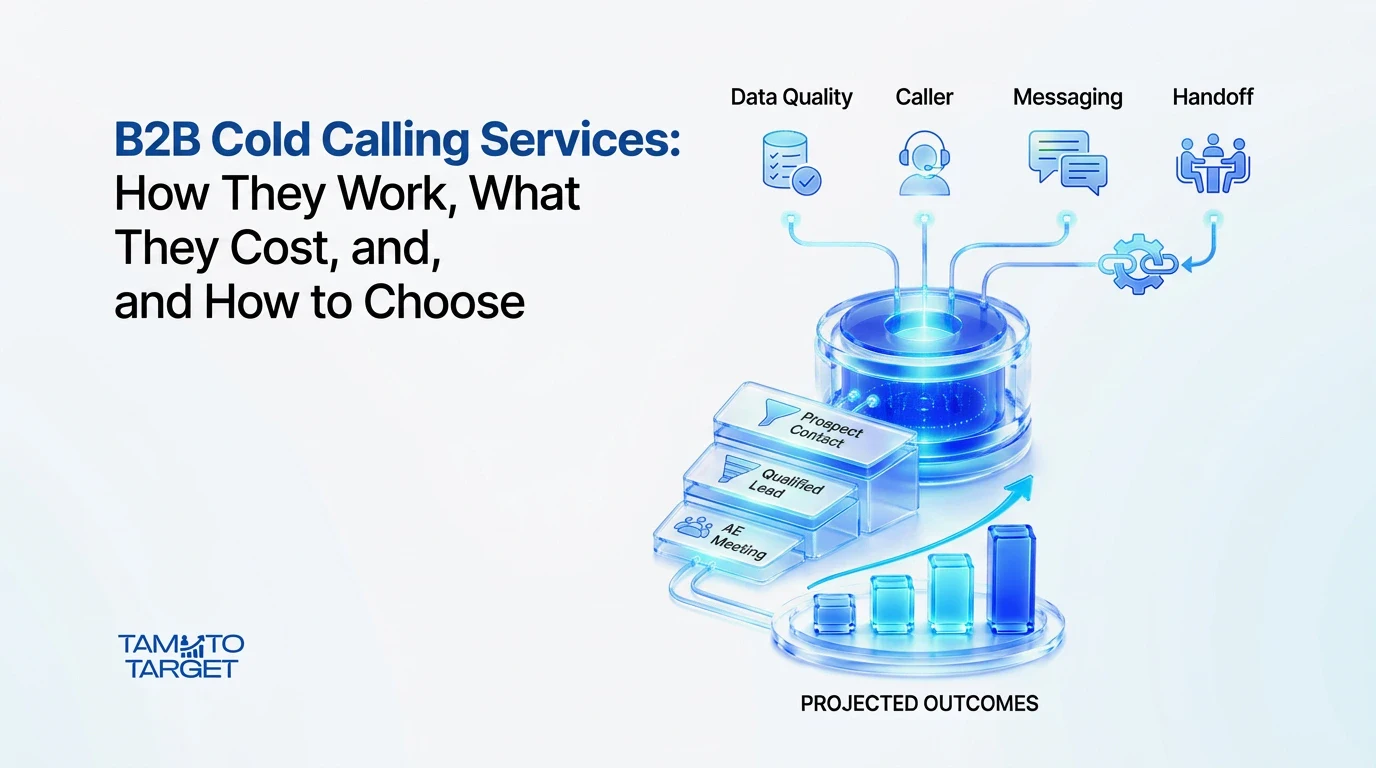
What Are B2B Cold Calling Services?
B2B cold calling services are outside teams that call businesses you haven't spoken to yet. They start conversations, check whether the prospect is a fit, and book meetings for your account executives (AEs). The result you should expect is qualified meetings on your calendar.
A few terms overlap here, so let's sort them out. Cold calling is the act of phoning a prospect with no prior relationship. Appointment setting is the goal of that call: getting a meeting booked.
SDR services go wider. An SDR (sales development representative) handles calls, emails, and follow-up across the full early stage of the funnel. If you want the full picture, here's what SDR services include.
Outsourced cold calling works best as one part of a pipeline system, and the best B2B cold calling services are built that way. The calls depend on a good list, a clear message, and a tight handoff to your AEs. When any of those pieces break, more dials won't save the program.
1 Why Companies Outsource Instead of Hiring In-House
Building an in-house SDR team takes money and patience: you recruit, train, buy tools, and wait for each rep to ramp. According to Bridge Group SDR benchmarks (2025 survey of 351 mostly SaaS companies with in-house SDR teams), average SDR ramp is 3.0 months. Average tenure is 1.9 years.
That math is tough. A rep spends months learning the role, then may leave less than two years later. Each departure restarts the hiring and ramp cycle.
Outsourcing also protects your AEs' time. Every hour an AE spends prospecting is an hour they aren't running demos or closing. In our work, B2B cold calling services can book meetings sooner because the team, tools, and process already exist.
The Three Main Service Models
Most B2B cold calling services fall into one of three models. Each one changes what you pay for, who manages the callers, and how much control you keep. If you sell into a market where you know every account by name, the model matters even more.
| Model | What You Pay For | Who Manages the Callers | Best For |
|---|---|---|---|
| Managed program | A monthly fee for strategy, data, callers, and reporting | The provider | Teams that want a full system without building one |
| Pay-per-appointment | A set fee for each meeting booked | The provider | Large markets where testing demand is the main goal |
| Dedicated caller staffing | Monthly cost for one or more full-time callers | You | Teams with strong sales management already in place |
Pay-per-appointment sounds safe because you only pay for results. The catch is that it rewards the provider for booking meetings, whether or not they're good ones. In a finite market, a string of weak meetings can burn accounts you can't replace.
A managed program puts strategy and execution under one roof. Our managed SDR services follow this model for companies selling into education and government.
How Much Do B2B Cold Calling Services Cost?
Pricing varies widely, so treat these as approximate ranges. In our experience, quotes we see tend to fall around $2,000 to $4,000 per month for dedicated offshore callers. For managed programs, they tend to fall around $3,500 to $10,000 or more per month, depending on scope.
The monthly quote rarely tells the whole story. Before you compare vendors, ask what's included in each price:
- Data: Contact lists, direct dials, and ongoing list cleanup can be extra.
- Dialer and tools: Calling software, recording, and phone numbers may carry separate fees.
- Setup: Some providers charge for onboarding, scripting, and CRM connection.
- Management: Coaching, QA, and reporting may be built in or billed on top.
The best way to compare offers is cost per qualified meeting held. A qualified meeting is one with a prospect who fits your ideal customer profile and shows up. Divide the total monthly cost by the number of those meetings.
Here's a simple, hypothetical example. Vendor A charges $3,000 a month and delivers 3 qualified meetings held, so each one costs $1,000. Vendor B charges $6,000 and delivers 10, so each one costs $600.
The cheaper monthly quote turned out to be the more expensive option. In our experience, that pattern is common, especially when low prices come from thin data or rushed callers.
How Effective B2B Cold Calling Actually Works
Effective B2B cold calling services follow an order of operations. Our K-12 Lead Generation Framework uses three pillars in this sequence: data quality, then volume and messaging, then signal enrichment. Skip a step, and the steps after it get weaker.
Here's how each step works in practice.
1 Start With a Clean List
Your list is the first lever you can pull. In our framework, we put it bluntly: "A smaller list with 100% accurate data will outperform a larger list with 70% accuracy every time."
A clean list means three things. Each contact has a verified direct dial, a current job title, and the correct organization attached. Bad data wastes dials and gets your callers talking to people who left months ago.
For a minimum viable campaign, we recommend 500+ qualified contacts and 3-5 messaging variations. That gives you enough volume to learn what works. If your list needs work first, start with TAM mapping and enrichment, which means sizing your total addressable market and filling in accurate contact data.
2 Build Volume, Then Test Your Message
Once the list is solid, volume comes next. Across dozens of our K-12 campaigns, these are the daily benchmarks we set for each SDR:
- Dials: 150-250 per day is the minimum.
- Live conversations: 15-20 per day is the target.
- Meetings booked: 2-3 per day is the gold standard.
Our outbound mix is phone-first: 80% calls and 20% emails. K-12 decision-makers, in our experience, "are not inbox-dwellers." The phone reaches them in ways email often can't.
With volume in place, you can test your message. Rotate your 3-5 variations, track which ones lead to conversations, and drop the weak ones.
3 Use Signals to Decide Who to Call First
A buying signal is an event that suggests an account may be ready to buy. Examples include budget approvals, leadership changes, and grant awards. A common mistake we see in our work is starting with signals and only calling accounts that show them.
We take a different view. Signals tell you "who to call first." They don't tell you "who to call only."
If you only call signal accounts, your list shrinks fast and you miss buyers who haven't made news yet. Use signals to rank your list, then keep calling the rest. Our guide to signal-based K-12 prospecting shows how to find these signals in public board meeting data.
4 What Is the 80/20 Rule in Cold Calling?
The 80/20 rule, also called the Pareto principle, is the idea that a small share of effort tends to drive most results. Applied to cold calling, the idea is that a small group of accounts or activities may produce most of your meetings. If so, the lesson is to find that group and focus there.
At TAM To Target, the 80/20 rule has a second meaning. It describes our outreach mix: 80% of effort goes to phone calls and 20% goes to email. For buyers who rarely live in their inbox, that split keeps the phone at the center of the program.
Metrics That Show Whether a Program Is Working
Dials alone don't tell you much. You need a set of metrics that tracks the full path from first call to pipeline. Here are the six we watch most closely:
- Connect rate: The share of dials that reach a live person.
- Conversation rate: The share of connects that turn into real conversations.
- Qualified meeting rate: The share of conversations that become meetings with good-fit buyers.
- Meetings held: The number of booked meetings that actually happen.
- Pipeline created: The dollar value of opportunities those meetings produce.
- Cost per meeting: Total program cost divided by qualified meetings held.
Connect rates vary a lot between average and great performers. Gong Labs cold calling data, published in July 2024, is Gong's analysis of its own customers' calls. In that analysis, the average rep connects on 5.4% of dials, versus 13.3% for the top quartile.
We see a similar gap in our own K-12 work. Top campaigns get 10-12 connects per day, while struggling ones get 1-2. That 5-10x difference comes down to dialing volume and list quality.
Before you launch any B2B cold calling services, agree on what counts as a qualified meeting. Write down the titles, account types, and buying criteria that make a meeting count. Our outbound lead qualification guide walks through how to set that bar.
Is B2B Cold Calling Legal in the US?
Generally, yes. The FTC's Telemarketing Sales Rule (TSR) sets rules for sales calls, and it treats business calls differently from consumer calls. The FTC Telemarketing Sales Rule guide states that "most phone calls between a telemarketer and a business are exempt from the TSR."
There are exceptions. Calls selling nondurable office or cleaning supplies to businesses are still covered. So are calls that pitch employees on personal purchases.
Other rules still apply even when the TSR doesn't:
- TCPA: Check how the Telephone Consumer Protection Act applies to your dialing tools and call methods.
- State laws: Check whether the states you call into have their own calling rules.
- Call-recording consent: Check the recording consent rules that apply before you record any calls.
When you talk to a provider, ask one direct question: who owns compliance? You want a clear answer, in writing, about who tracks the rules and who is responsible if something goes wrong. This is general information, so check with your legal team before you launch.
Where AI Fits in Outsourced Cold Calling
AI can make human callers faster and sharper. It helps with account research, call notes, CRM updates, and coaching. That frees callers to spend more time in live conversations.
The FCC AI voice ruling confirmed that AI-generated voices count as "artificial" voices under the TCPA. In the FCC's words, those restrictions "encompass current AI technologies that generate human voices." Calls using artificial voices generally require prior consent, so ask your vendor how they handle it.
Ask every vendor how they use AI. Find out which tasks it handles, whether any calls use AI-generated voices, and how they stay compliant.
Cold Calling in Finite Markets Like K-12 and Higher Ed
A finite market is one where you can count every possible buyer. K-12 is a clear example. NCES public school counts list 13,318 regular public school districts in the 2022-23 school year.
In a market that size, reputation travels. Superintendents, CIOs, and procurement directors talk to each other. A pushy call in one district can follow you into the next one, and you can't just move on to a new territory.
That's why we use a pod model. No SDR works alone. Each caller is part of a team that shares notes, coaching, and account context, so every call reflects well on your brand.
This approach has produced strong results for our clients:
- A K-12 student services provider: Booked 80+ meetings in six months, a 400% increase, using SDR support, competitive intel, and signal-based outbound.
- A charter school development nonprofit: Booked 15+ qualified meetings in 45 days.
If you sell into education or government, see how we approach K-12 and Higher Ed sales.
How to Vet a Cold Calling Partner Before You Sign
The right partner can fill your calendar. The wrong one can drain your budget and hurt your name with buyers. Use this checklist on every sales call with companies offering B2B cold calling services.
| What to Check | Question to Ask | What a Good Answer Looks Like |
|---|---|---|
| Caller exclusivity | Will my callers work on other clients' campaigns? | Dedicated callers, or a clear limit on shared time |
| Qualified meeting definition | How do you define a qualified meeting? | A written definition you agree on before launch |
| Data and CRM ownership | Who owns the contacts, notes, and call records? | You own all of it, during and after the contract |
| Compliance owner | Who is responsible for TCPA and state rules? | A named owner and a written process |
| Reporting | What will I see each week? | Connects, conversations, meetings held, and pipeline |
| Contract terms | What is the minimum term and exit process? | Clear terms with a fair exit window |
| US vs. offshore fit | How do your callers know my buyers? | Proof of skill and buyer familiarity |
The US-based vs. offshore question deserves a closer look. Geography alone won't tell you much about quality. Judge callers on skill, training, and how well they understand your buyers.
For more on comparing vendors, read our guide to choosing an appointment setting partner.
FAQs About B2B Cold Calling Services
How Much Do B2B Cold Calling Services Cost?
In our experience, quotes we see tend to fall around $2,000-$4,000 per month for dedicated offshore callers and $3,500-$10,000+ for managed programs. Compare offers by cost per qualified meeting held, since we've seen the cheapest quote cost more per meeting.
Should I Hire US-Based or Offshore Cold Callers?
Choose based on caller skill, training, and familiarity with your buyers rather than location alone. Ask for call recordings and proof of results in your market before you decide.
Who Owns the Leads and CRM Data?
You should own every contact, note, and call record, both during and after the contract. Get this in writing before you sign.
Can Outsourced Cold Callers Work in HubSpot or My Existing CRM?
Many providers can work inside common CRMs like HubSpot, so ask before you sign whether yours can log every activity there. Confirm the setup process and data ownership terms during vetting.
How Long Until an Outsourced Program Shows Results?
Timing depends on your list, market, and sales cycle, but a strong program can show early meetings within weeks. One of our charter school development nonprofit clients booked 15+ qualified meetings in 45 days.
Build Cold Calling Into a Pipeline System
B2B cold calling services work best when they sit inside a full pipeline system. Start with a clean list, build daily volume, and use signals to decide who to call first. Measure qualified meetings held, and vet partners on data ownership, compliance, and caller skill.
In finite markets like K-12 and Higher Ed, every call shapes your reputation. Treat each one with care, and the meetings will follow.
Schedule time with our team and we'll help you find your next $500k in pipeline.
Blogs

Explore Our Articles
Stay ahead with cutting-edge strategies and insights from industry experts
15 min read
Best SDR and Lead Generation Agencies for SLED in 2026: A Buyer’s Guide to Lead Generation for SLED
Lead generation for SLED is a different job than commercial B2B prospecting. SLED stands for state, local, and education buyers, and each of them buys on public rules and public calendars. This guide compares the agencies worth a look in 2026 and shows you how to vet them.
Read Article
11 min read
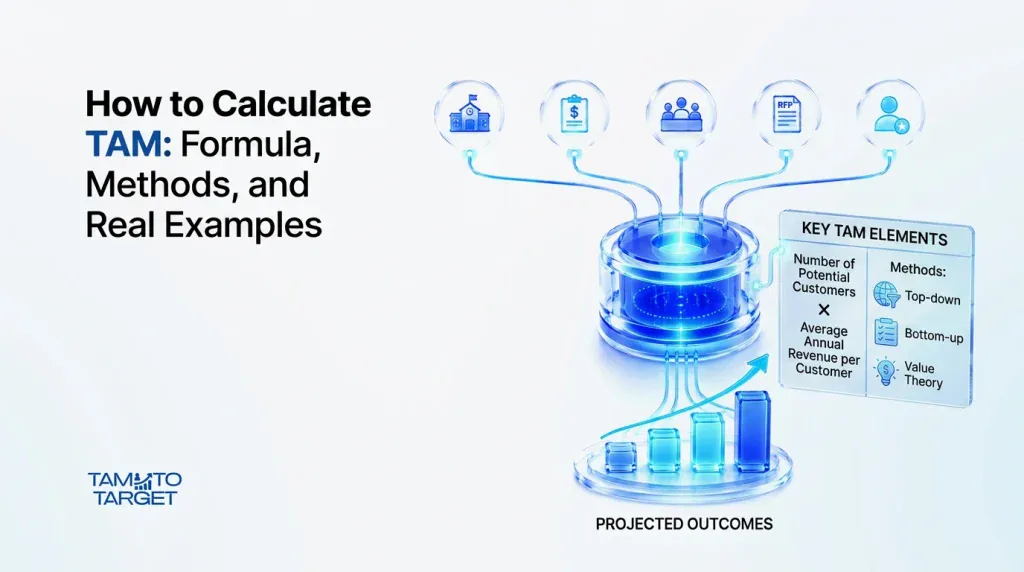
How to Calculate TAM: Formula, Methods, and Real Examples
If you need a market number for a board deck or a pipeline plan, learning how to calculate TAM is the place to start. The math is simpler than it looks. This guide covers the formula, the three main methods, and worked examples from K-12, higher ed, and local government.
Read Article
11 min read
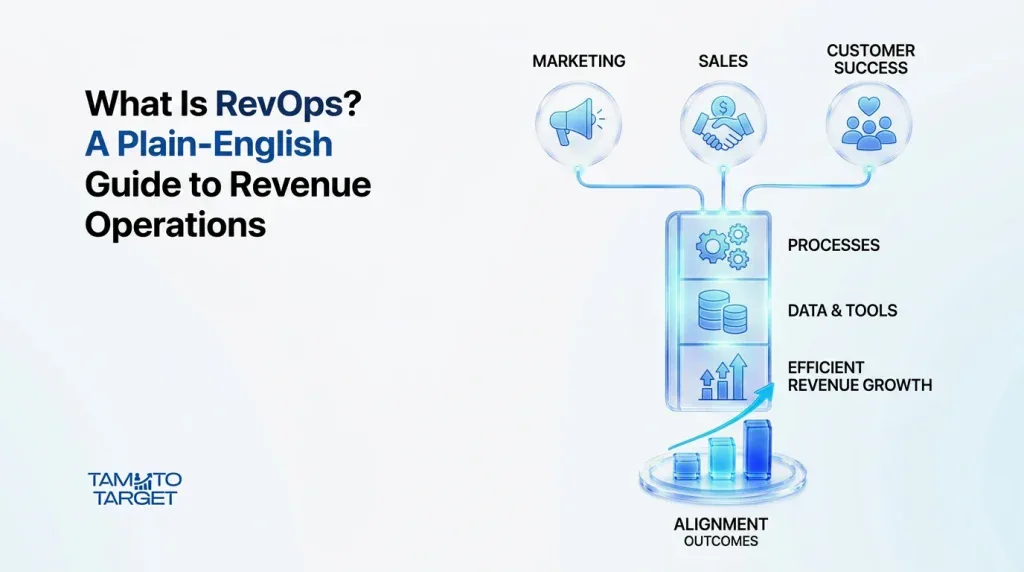
What Is RevOps? A Plain-English Guide to Revenue Operations
Your sales team says marketing sends bad leads. Marketing says sales never follows up. Meanwhile, customer success hears about new accounts a week late. If that sounds familiar, you’re probably asking: what is RevOps, and do we need it? This guide covers the definition, the four pillars, key metrics, and how to start without hiring […]
Read Article
12 min read
HubSpot Deal Stages: How to Set Up, Customize, and Forecast With Them
Your pipeline report says you’ll hit the number. Then half your late-stage deals slip into next quarter. Often, the cause is how your HubSpot deal stages are defined. This guide explains what deal stages are, how HubSpot’s defaults work, and how to customize them. You’ll also learn how to set entry and exit criteria, automate […]
Read Article
17 min read
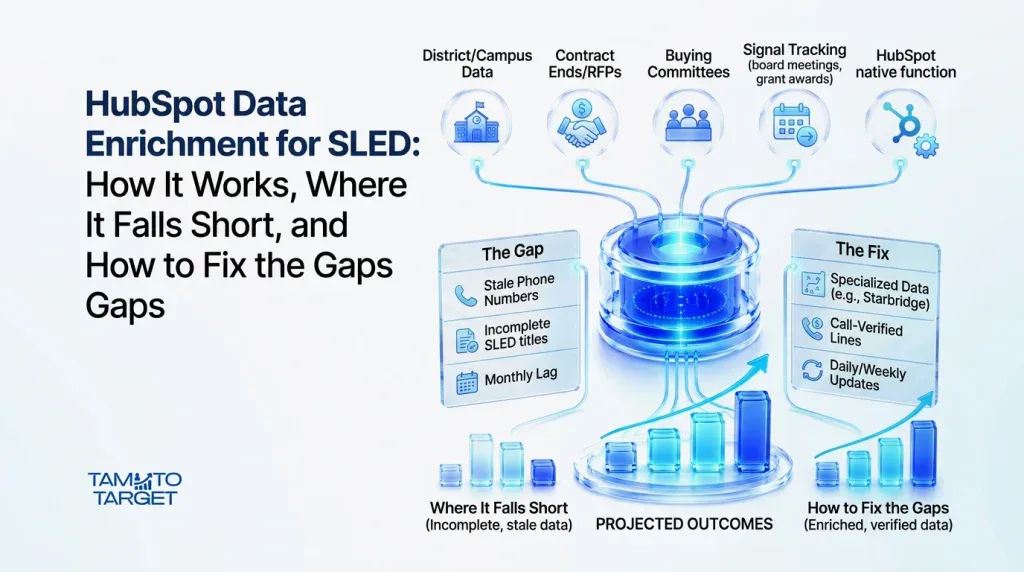
HubSpot Data Enrichment for SLED: How It Works, Where It Falls Short, and How to Fix the Gaps
Most HubSpot records start thin. A form fill gives you a name and an email, and maybe a job title if you asked for one. HubSpot data enrichment fills in the rest, so your team isn’t guessing who they’re talking to. Thin records are common. In July 2026, Validity surveyed 500 B2B and B2C marketing […]
Read Article

10 min read
What Is B2G Sales? A Beginner’s Guide to Business to Government Sales
If your team sells to schools, cities, or state agencies, you’re already doing B2G sales, even if nobody calls it that. Business to government sales follows its own rules, calendars, and buying habits. This guide covers what B2G means, how it differs from B2B and B2C, and how public agencies actually buy. You’ll also learn […]
Read Article
Ready to build pipeline in the gov + edu market?
Book a call and we'll show you exactly how we get your motion live and generating qualified meetings.
Book a Call