

Published
12 min read
What Are HubSpot Deal Stages?
HubSpot deal stages are the steps in a sales pipeline that show how far a deal has progressed toward closing. Each stage has a probability, which HubSpot uses to calculate a weighted value for your pipeline.
A few key terms:
- Deal: A HubSpot record that tracks a potential sale, including its amount, contacts, and expected close date.
- Pipeline: The ordered set of stages a deal moves through, from first meeting to closed won or closed lost.
- Stage probability: The percent chance of closing assigned to a stage, used to weight deal amounts in reports.
At TAM To Target, we treat each deal stage as a record of what the buyer has committed to. "Demo delivered" describes what your rep did. "Champion confirmed the budget source" describes what the buyer did, and that tells you far more about whether the deal will close.
HubSpot's Default Deal Stages and Probabilities
HubSpot's Knowledge Base page on HubSpot default deal stages states, "The default pipeline has seven deal stages: Appointment scheduled (20%), Qualified to buy (40%), Presentation scheduled (60%), Decision maker bought-in (80%), Contract sent (90%), Closed won (100%, Won), Closed lost (0%, Lost)."
| Default Stage | Default Probability | Typical Meaning |
|---|---|---|
| Appointment scheduled | 20% | A first meeting is on the calendar. |
| Qualified to buy | 40% | The prospect fits your criteria and has a real need. |
| Presentation scheduled | 60% | A demo or proposal meeting is booked. |
| Decision maker bought-in | 80% | The person who signs off supports the purchase. |
| Contract sent | 90% | Paperwork is with the buyer for review. |
| Closed won | 100% (Won) | The deal is signed. |
| Closed lost | 0% (Lost) | The deal is no longer moving forward. |
These defaults mirror the classic 7 stage sales cycle: book, qualify, present, approve, contract, and close.
HubSpot's Knowledge Base also explains that stage probability drives the weighted amount in board view. Board view is the column-by-stage layout of your deals. HubSpot multiplies the total amount in each column by that stage's probability.
Two facts matter here. First, the stages and probabilities are editable defaults, so you can change names, order, and percentages. Second, the percentages are preset inputs, not measured close rates from your own deals.
How to Set Up and Customize Deal Stages in HubSpot
You customize HubSpot deal stages in your account settings. According to HubSpot's Knowledge Base, you need Edit property settings permissions to create and edit pipelines or stages. Confirm who holds it before you start.
You'll also use HubSpot deal properties. These are the fields stored on each deal, such as amount, close date, and deal owner.
1 Add, Edit, Reorder, and Delete Stages
Here's the basic setup path. Menu labels may differ slightly in your account.
- Click the settings icon in the top navigation bar.
- Go to Objects, then Deals, in the left sidebar.
- Open the Pipelines tab and select the pipeline you want to edit.
- Add a stage, name it, and set its deal probability.
- Drag stages into the right order, edit or delete any you don't need, then save.
HubSpot's Knowledge Base notes that deal pipelines must include both a Won and a Lost stage. Without them, sales reports and analytics tools can't process your deals correctly. You also can't delete a stage that has blocking references, such as deals still sitting in it, so move those deals first.
Name each deal stage after what the buyer did, so it reflects evidence instead of effort.
- Rename "Demo Completed": Use "Use Case Confirmed" so the stage reflects buyer agreement.
- Rename "Proposal Sent": Use "Business Case Accepted" so the stage reflects a buyer response.
- Rename "Follow-Up": Replace vague holding stages with a clear next buyer commitment.
2 Use Conditional Stage Properties
Conditional stage properties show selected fields when a user manually creates a deal in, or moves a deal to, a specific stage. You can mark any of those fields as Required. Per HubSpot's Knowledge Base, users then can't create or update the record until they fill it in.
This is the cleanest way to capture committee and funding details at the right moment. For example:
- Entering Solution Fit: Require the primary problem and the buyer's decision timeline.
- Entering Champion Confirmed: Require the champion's name and role.
- Entering Funding Identified: Require the budget source, such as general funds, a grant, or Title funding.
- Entering Procurement: Require the procurement contact and the purchasing method.
Keep two limits in mind. HubSpot documents this feature for manual creates and moves, so don't assume it covers imports or automated changes. Read-only fields, such as score or calculation properties, can't be used as stage properties.
3 One Pipeline or Many?
Create a separate pipeline only when the sales process truly differs. If the steps are the same and only the product changes, one pipeline with a product property is easier to manage.
- New business vs. renewals: Renewals skip discovery and follow the contract calendar, so they deserve their own stages.
- District vs. site-level sales: A district deal often needs board and procurement approval, while a single-school purchase may not.
HubSpot's Knowledge Base lists custom pipeline limits by subscription and pricing model. These limits are shared across all objects, such as deals and tickets, and don't count each object's default pipeline.
| Subscription | Seat-Based Pricing | Flexible Seats & Credits |
|---|---|---|
| Free tools | 0 custom pipelines | 0 custom pipelines |
| Starter | 15 custom pipelines | 15 custom pipelines |
| Professional | 100 custom pipelines | 350 custom pipelines |
| Enterprise | 350 custom pipelines | 350 custom pipelines |
Plan before you build. HubSpot won't let you delete a pipeline that contains records or is used in other HubSpot tools or integrations.
Define Entry and Exit Criteria for Every Stage
Stage names alone leave too much room for interpretation, so every HubSpot deal stage needs written criteria. Entry criteria are the conditions a deal must meet to enter a stage. Exit criteria are the conditions that must be true before it moves forward.
When every rep uses the same criteria, a deal in "Committee Alignment" means the same thing on every team. That consistency is what makes your forecast trustworthy. We define each stage with four parts:
- Purpose: The job the stage exists to do.
- Entry criteria: The proof required for a deal to land in this stage.
- Exit criteria: The proof required before the deal can advance.
- Buyer signal: A verifiable buyer action, such as an email, a meeting invite, or a shared document.
Here's an example for a long-cycle B2B pipeline:
| Stage | Entry Criteria | Exit Criteria | Buyer Signal |
|---|---|---|---|
| Discovery | First meeting held with a relevant contact | Problem and timeline documented | Buyer shares current process or data |
| Solution Fit | Clear problem your product solves | Buyer agrees on use case and success metrics | Buyer invites a colleague to the next call |
| Champion Confirmed | An internal advocate is identified | Champion agrees to lead the internal case | Champion shares the approval process |
| Funding Identified | Champion has outlined the budget path | Budget source and amount confirmed | Buyer names the funding line or grant |
| Committee Alignment | All decision makers are known | Committee members approve moving forward | Approval noted in writing or minutes |
| Procurement | Buyer requests a contract or quote | Contract terms agreed | Purchase order or signed agreement |
Committee sign-off belongs in the exit criteria for late stages. Our guide to public-sector buying committees covers how to map those stakeholders. You can also align your criteria with one of the top sales methodologies, so your stages and your discovery questions speak the same language.
Rebuild Stages for Long, Multi-Stakeholder Sales
In TAM To Target's view, the default HubSpot deal stages assume a short, linear sale. A meeting leads to a demo, a demo leads to a contract, and one decision maker says yes. Deals in education and government rarely move that way.
Buyers also do more research on their own. In a Gartner rep-free buyer survey, "67% of B2B buyers state that they prefer a rep-free experience, according to a survey by Gartner, Inc." Stages built around rep meetings can miss much of the progress happening between those meetings.
Here's how we typically map the defaults to a longer, committee-driven process:
| Default Stage | Long-Cycle Replacement | What Changes |
|---|---|---|
| Appointment scheduled | Discovery | Counts a held meeting with a relevant contact, not a calendar invite |
| Qualified to buy | Solution Fit | Requires agreement on the use case |
| Presentation scheduled | Champion Confirmed | Tracks an internal advocate instead of a demo date |
| Decision maker bought-in | Funding Identified | Confirms where the money comes from |
| Decision maker bought-in | Committee Alignment | Replaces one approver with the full group |
| Contract sent | Procurement | Covers quotes, vendor forms, and legal review |
| Closed won / Closed lost | Closed Won / Closed Lost | Stays the same, as HubSpot requires |
Don't copy the default percentages onto your new stages. Start with a reasonable estimate, then replace it with your own history once you have enough closed deals.
For long, multi-year buyer journeys, we recommend pairing your stages with custom objects, nurture workflows for each readiness stage, and pipeline health dashboards. If your buyers follow a similar path, see how we approach HubSpot implementation for K-12 sellers.
Automate Actions When Deals Change Stages
Stage changes are natural triggers for automation. HubSpot workflows are rules that run actions automatically when something happens, such as a deal entering a stage. Good deal management uses them to remove busywork and keep data clean.
- Create tasks: Assign a follow-up task to the deal owner when a deal enters a new stage.
- Notify managers: Alert a sales leader when a large deal reaches Committee Alignment or Procurement.
- Update properties: Stamp the date a deal entered each stage so you can measure time in stage.
- Manage outreach: Pause marketing or prospecting emails to contacts on deals already in late stages.
That last point matters in finite markets. Superintendents and procurement directors talk to each other. A cold email sent to a buyer in contract review signals that your team isn't paying attention.
Stage-based automation also cuts down on manual updates. That gives reps more time to spend with buyers.
Use Deal Stages for Forecasting and Reporting
Stage probabilities flow straight into your forecast. HubSpot's Knowledge Base on HubSpot forecast tool setup defines it this way: "Weighted amount: the Amount multiplied by the Deal probability." The same page says users with Forecast permissions are set to use weighted amount by default.
The forecast tool is available in Sales Hub and Service Hub Professional and Enterprise. Super Admin permissions are required to set it up. It also uses forecast categories, such as Pipeline, Best case, and Commit, which are mapped from stages but can be changed on a deal.
Weighted amount is only as good as your probabilities. Track these metrics too:
- Stage conversion rate: The share of deals that move from one stage to the next.
- Time in stage: The average days a deal spends in each stage before moving or closing.
- Win rate: The share of closed deals that end as Closed Won.
- Deal velocity: How fast pipeline turns into revenue, calculated as deals × average deal size × win rate ÷ cycle length.
For more, read our guide to metrics for long sales cycles.
Use time in stage to run stalled deal reviews. Flag any deal that sits well past the average for its stage, then confirm the next buyer action or move it back.
Then calibrate your probabilities. Pull a year or more of closed deals, check what share from each stage ended up won, and update the percentages.
A HubSpot deal score or custom score can add a second view of each deal's health. Pair it with an account scoring model so you know which open deals sit at your best-fit accounts.
Roll Out New Stages Without Losing Your Team
New HubSpot deal stages only work if reps use them the same way. A rollout plan keeps adoption high and protects your reporting.
- Involve reps early: Ask your top sellers to review draft stages and criteria before launch.
- Map old stages to new: Decide where every open deal moves, then update them in bulk.
- Document definitions: Store each stage's purpose, criteria, and buyer signal in one shared place.
- Train the team: Walk through real deals in each stage so the criteria feel concrete.
- Review weekly: Use pipeline meetings to flag deals that don't meet their stage criteria.
No full-time HubSpot admin? Our fractional RevOps support can handle the rebuild, rollout, and cleanup. For a broader pipeline and reporting overhaul, explore our modern GTM RevOps services.
Frequently Asked Questions
Here are quick answers to common questions about deal pipelines.
How Many Pipelines Can I Create in HubSpot?
It depends on your subscription and pricing model, and limits are shared across all objects. Seat-based Professional accounts get 100 custom pipelines, while Flexible Seats & Credits Professional accounts get 350.
Who Can Edit HubSpot Deal Stages?
Any user with Edit property settings permissions can create and edit pipelines and stages. That same permission is required to set up conditional stage properties.
Can I Change HubSpot's Default Stage Probabilities?
Yes, you can enter a custom probability for any stage. We recommend updating them based on your own historical win rates by stage.
How Do I Automate Actions When a Deal Stage Changes?
Build a deal-based workflow that triggers when the deal stage property changes to a specific value. Then add actions such as creating tasks, sending internal notifications, or updating properties.
How Many Stages Should a Deal Pipeline Have?
HubSpot's default pipeline uses seven stages, including Closed won and Closed lost. In our view, the right number is the fewest stages that still show a clear buyer commitment at each step.
Build HubSpot Deal Stages That Match How Your Buyers Buy
Strong HubSpot deal stages track buyer commitments, use clear entry and exit criteria, and carry probabilities based on your own history. Add conditional properties, smart automation, and regular reviews, and your forecast becomes something your leadership team can trust.
If your pipeline feels more like a guess than a system, we can help. Schedule time with our team and we'll help you find your next $500k in pipeline.
Blogs

Explore Our Articles
Stay ahead with cutting-edge strategies and insights from industry experts
15 min read
Best SDR and Lead Generation Agencies for SLED in 2026: A Buyer’s Guide to Lead Generation for SLED
Lead generation for SLED is a different job than commercial B2B prospecting. SLED stands for state, local, and education buyers, and each of them buys on public rules and public calendars. This guide compares the agencies worth a look in 2026 and shows you how to vet them.
Read Article
11 min read
How to Calculate TAM: Formula, Methods, and Real Examples
If you need a market number for a board deck or a pipeline plan, learning how to calculate TAM is the place to start. The math is simpler than it looks. This guide covers the formula, the three main methods, and worked examples from K-12, higher ed, and local government.
Read Article
13 min read
B2B Cold Calling Services: How They Work, What They Cost, and How to Choose
Your AEs should spend their time closing deals. Too often, they spend it hunting for the next meeting instead. B2B cold calling services fix that by handing first conversations to a trained outside team. This guide covers how these services work, what they cost, and how to pick a partner. You’ll also get benchmarks from […]
Read Article
11 min read
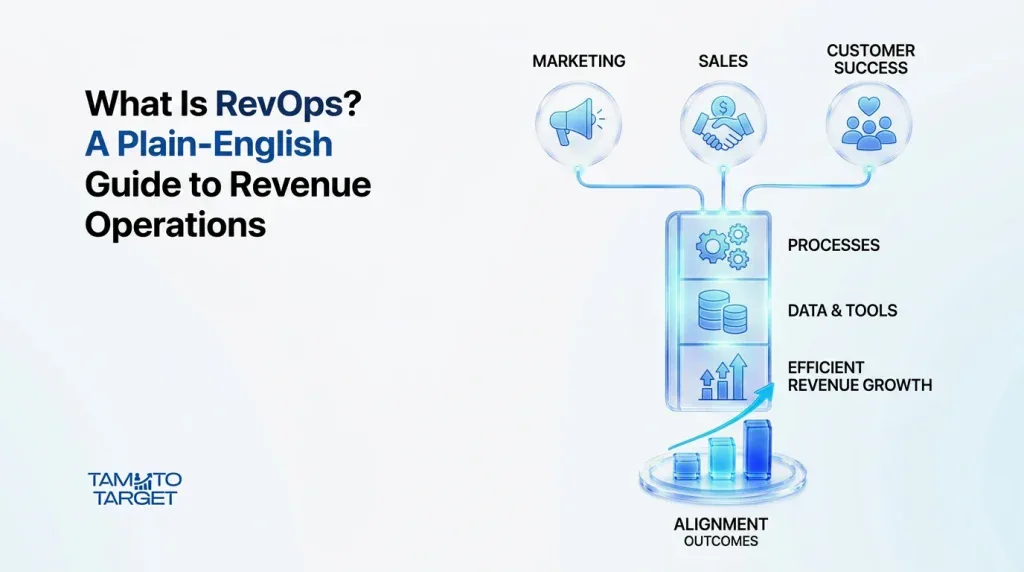
What Is RevOps? A Plain-English Guide to Revenue Operations
Your sales team says marketing sends bad leads. Marketing says sales never follows up. Meanwhile, customer success hears about new accounts a week late. If that sounds familiar, you’re probably asking: what is RevOps, and do we need it? This guide covers the definition, the four pillars, key metrics, and how to start without hiring […]
Read Article
17 min read
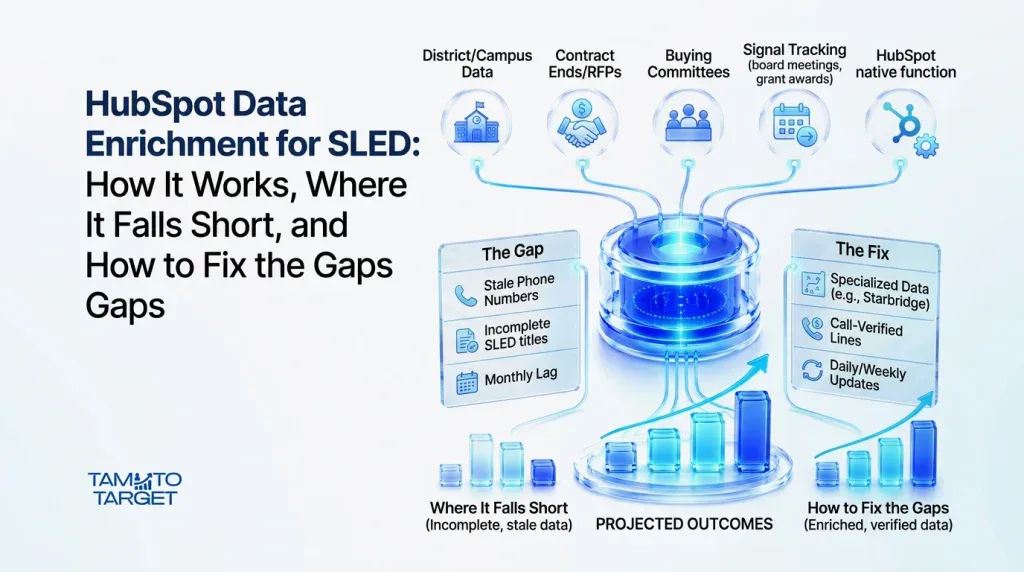
HubSpot Data Enrichment for SLED: How It Works, Where It Falls Short, and How to Fix the Gaps
Most HubSpot records start thin. A form fill gives you a name and an email, and maybe a job title if you asked for one. HubSpot data enrichment fills in the rest, so your team isn’t guessing who they’re talking to. Thin records are common. In July 2026, Validity surveyed 500 B2B and B2C marketing […]
Read Article

10 min read
What Is B2G Sales? A Beginner’s Guide to Business to Government Sales
If your team sells to schools, cities, or state agencies, you’re already doing B2G sales, even if nobody calls it that. Business to government sales follows its own rules, calendars, and buying habits. This guide covers what B2G means, how it differs from B2B and B2C, and how public agencies actually buy. You’ll also learn […]
Read Article
Ready to build pipeline in the gov + edu market?
Book a call and we'll show you exactly how we get your motion live and generating qualified meetings.
Book a Call