

Published
15 min read
What Is the Best SDR and Lead Generation Agency for SLED?
The best SDR and lead generation agency for SLED combines three things: public-sector domain expertise, signal-based targeting, and dedicated SDRs. Signal-based targeting means outreach is timed to open RFPs, board votes, and approved budgets instead of a static list. Generic B2B shops rarely fit, because they are built for large markets where a burned contact is easy to replace.
An SDR (sales development representative) is the rep who books first meetings for your account executives. If you are new to the category, start with what SLED sales means before you compare vendors.
Here is a quick way to match the agency shape to your situation:
- SLED-native partner: Best when public-sector revenue is your main growth bet and you need strategy, systems, and SDRs together.
- Phone-first US agency: Best when you already know your target agencies and need more live conversations.
- Research-led email agency: Best when buying committees are large and you need multi-threaded outreach to several roles.
- Embedded SDR provider: Best when you plan to hire the SDR in-house after a pilot.
Most of the best B2B lead generation companies on public lists were not designed for government buyers. The sections below show where each one fits and where it does not.
Why Lead Generation for SLED Is Different
SLED buyers sit in a market you can count, and they talk to each other. A superintendent, a county CIO, and a state procurement officer often share the same conferences and peer groups. One careless touch can close a door across a whole region.
The Census Bureau local government count shows 90,837 total local governments in the United States, based on the 2022 Census of Governments. That sounds large until you filter for the ones that fit your product, budget size, and region.
1 A Finite, Countable Market
Your TAM (total addressable market) in SLED is a fixed list you can count. The NCES public school district counts put the number at 13,318 regular public school districts in 2022-23. If you sell to districts, that is close to your whole universe.
The money behind that list is real. According to BEA state and local expenditures, state and local governments spent over $5 trillion in 2024. That figure is total spending, not procurement spend, so treat it as market context rather than your addressable budget.
For technology lead generation in this market, the first job is mapping every account you could sell to. Our guide to limited TAM strategy walks through that process in more detail.
2 Committees, Procurement, and Budget Calendars
Public-sector deals involve many people. Gartner buying group research found buying groups range from five to 16 people across as many as four functions. That study covers B2B buyers in general, and SLED committees often add procurement, legal, and elected boards on top.
Budget calendars set the pace. The NASBO fiscal year start dates report notes that forty-six states begin their fiscal year on July 1. That data covers state governments only, so check each city, county, and district calendar on its own.
Procurement rules and state contract vehicles work the same way. A state contract vehicle is a pre-approved agreement that lets agencies buy without running a new bid. Smart teams treat these rules as timing signals, and the government procurement cycle shows when each window opens.
The Four Types of Lead Generation Providers
Not every B2B lead agency does the same work. Most providers fall into one of four groups, and each one fits SLED differently.
| Provider Type | What It Does | SLED Fit |
|---|---|---|
| Data platforms | Software such as ZoomInfo, Apollo, or Cognism that sells contact data | Useful for contacts, but no procurement or budget context |
| Appointment-setting agencies | SDRs who call and email to book meetings | Strong if reps know public-sector buying; weak if they run volume scripts |
| Demand gen shops | Content, ads, and events that build inbound interest | Helpful for awareness, but slow to create meetings in a finite market |
| AI SDR platforms | Software that writes and sends outreach at scale | Risky alone in SLED, where tone and timing matter to each agency |
Buyers searching for the best b2b lead generation software often end up with a data platform. That covers one input. You still need signals, scoring, and people who can hold a credible conversation with a procurement director.
Best SDR and Lead Generation Agencies for SLED: Comparison Table
The table below compares nine providers on model, delivery, pricing, and SLED fit. Each 2026 price is labeled as published by the vendor or as reported or estimated by third-party roundups. Prices change often, so confirm every figure directly with the vendor.
| Agency | Model | Delivery | Pricing (2026) | SLED Fit | Watch-Outs |
|---|---|---|---|---|---|
| TAM To Target | GTM Engineering, GTM, RevOps, Cold Calling and Email Execution, and AEO/GEO ServIces | CRM-native GTM Systems, Dedicated SDRs | Starts at $2,500 per month | High; Built for K-12, Higher Ed, and state and local government. Exclusive partnership with Starbridge (starbridge.ai) | SLED Specific; not built for high-volume private sector outreach |
| SalesRoads | Appointment setting | US-based onshore, phone-first | Estimated ~$5K–$10K/mo (third-party); sources differ on whether a base price is published | Moderate; strong calling, no SLED signal layer | Narrower channel mix |
| Belkins | Appointment setting | Research-led; email core plus LinkedIn and calling | Not published; reported ~$5K–$15K/mo (third-party) | Moderate; good for large committees | Not SLED-specialized |
| memoryBlue | Embedded SDRs | Assigned SDRs with hire-out path | Reported $8K–$15K/mo (third-party) | Moderate; depends on SDR training | Absorbed Operatix; confirm current team |
| Martal Group | Fractional sales leadership plus SDRs | 3-month pilot (lead gen) or 4-month pilot (sales outsourcing) | Not published; reported ~$4.1K–$10.5K/mo (third-party) | Moderate; depends on SDR training | Confirm public-sector experience |
| Callbox | Global, multi-channel outreach | Offshore-heavy per Leadium; says it serves 50+ countries | Not confirmed; request a quote | Low if run at volume in a finite TAM | Reputation risk in small markets |
| CIENCE (graph8) | Outsourced SDR services | Assets now under graph8 | Not confirmed; request a quote | Unclear after ownership change | Confirm who runs your account |
| Leadium | Boutique appointment setting | US-based | Published $3.5K–$5K/mo | Moderate; no SLED signal layer | Generic B2B focus |
| Alleyoop | Signal-driven outbound | Dedicated onshore Playmakers (per vendor) | Published $5,250–$14,750/mo | Moderate; signals are commercial, not public-sector | Six-month terms |
The SLED Fit column is our own view, based on each provider's stated model. Some third-party figures come from roundups by Alleyoop and Leadium, which are also agencies on this list. Use the table as a starting point for your own vendor calls.
Agency Profiles: SLED Fit and Cautions
We judged each provider on three questions. Does it know public-sector buying, does it use public-sector signals, and does its model protect a finite market?
You can also read how specialist public sector SDR teams differ from generalist agencies. Each profile below sticks to what fits SLED and what to watch.
1 TAM To Target
TAM To Target is a GTM (go-to-market) consulting and execution firm built for K-12, Higher Ed, and state and local government. It was founded by a former classroom teacher and is Starbridge's exclusive agency partner. We build a signal-based GTM operating system, then run the outbound with dedicated government and education SDRs.
Strategy, RevOps (revenue operations), and SDR execution sit with one team. Starbridge supplies signals such as board decisions, RFPs, leadership changes, budget approvals, and grant awards. TAM To Target client data shows a K-12 district platform provider booked 80+ meetings in six months, a 400% increase in qualified lead volume.
To be honest about fit, we are a newer firm. We focus on finite markets and are not the right partner for high-volume commercial outreach.
2 SalesRoads
SalesRoads is a US-based, onshore, phone-first agency, according to Alleyoop's 2026 agency roundup. Alleyoop says it does not appear to publish rates, though Martal's roundup says SalesRoads publishes its base program price. Third-party estimates run from about $5K to $10K a month.
The channel mix is narrower than most. It also lacks a SLED signal layer, so you would need to supply the account timing yourself.
3 Belkins
Belkins is research-led, with email at the core plus LinkedIn and calling. It does not publish rates. The same Alleyoop roundup reports about $5K–$15K per month, while Leadium reports about $6.5K–$8K.
Its research depth suits large buying committees. It is not SLED-specialized, so ask how its team handles procurement rules and board calendars.
4 memoryBlue
memoryBlue assigns SDRs to your account and offers a path to hire them in-house later. Third-party sources report pricing of $8K–$15K per month.
memoryBlue absorbed Operatix. Ask who will staff your program and whether they have sold to public agencies before.
5 Martal Group
Martal Group pairs fractional sales leadership with SDRs. Alleyoop reports about $4.1K–$10.5K per month, while Leadium reports a narrower $4.5K–$6.2K. Martal says it starts with a 3-month pilot for lead generation or 4 months for sales outsourcing.
A short pilot is useful, but SLED cycles are long. Agree up front on what a pilot can prove in that window.
6 Callbox, CIENCE, Leadium, and Alleyoop
These four round out the list, each with a different trade-off for SLED buyers.
- Callbox: A global provider that Leadium describes as high-volume and offshore-heavy. Callbox says it serves more than 50 countries.
- CIENCE: An SDR provider whose assets now sit under graph8, so confirm who manages delivery.
- Leadium: A boutique, US-based agency with published pricing of $3.5K–$5K per month.
- Alleyoop: A signal-driven agency with published pricing of $5,250–$14,750 per month and six-month terms. It uses dedicated onshore SDRs it calls Playmakers, per the vendor.
Signal-Based Prospecting: What Good SLED Lead Generation Looks Like
Good SLED lead generation starts with timing: when an agency is ready to buy. A buying signal is a public event that shows an agency has a need, a budget, or a deadline. Public-sector buyers leave these signals in meeting minutes and procurement portals.
SLED-native signals include:
- Board or council votes: A vote to fund a program or replace a system starts a clock.
- Open RFPs: A request for proposal (RFP) is a formal bid; read open RFPs as buying signals for timing.
- Approved bonds: Voter-approved bonds release capital for facilities, safety, and technology projects.
- Budget allocations: New line items show where money will go next fiscal year.
- Leadership changes: A new superintendent, CIO, or city manager often reviews existing vendors.
- Expiring contracts: An incumbent contract nearing its end opens a window to compete.
- Co-op participation: Membership in a purchasing cooperative can shorten the path to a purchase order.
That last signal matters more than many teams expect. A cooperative contract is a pre-bid agreement that many agencies can buy from. In the NASPO 2024 procurement survey, all 41 state respondents to that question reported purchasing from NASPO ValuePoint cooperative contracts.
Here is how the data flows in a working system:
- ICP plus signal: Start with your ICP (ideal customer profile) and add live public-sector signals from Starbridge.
- RevOps enrichment: Add CRM context, such as past deals, open opportunities, and existing contacts.
- 50/50 scoring: Score each account half on fit and half on signal strength.
- Action: Let the score decide messaging, targeting, and whether the SDR calls or emails first.
Our 50/50 account scoring model explains how each half is weighted. In practice, a K-12 STEM provider built $250k+ in Q4 pipeline using district-level signals, per TAM To Target client data.
Pricing Models and What They Incentivize
Each pricing model rewards a different behavior. Leadium's 2026 pricing roundup reports mid-market retainers of $3K–$8K per month and pay-per-meeting rates of $300–$800.
- Retainer: A flat monthly fee that rewards steady, careful work across long cycles.
- Pay-per-meeting: A fee per booked meeting that can reward volume over quality.
- Hybrid: A lower retainer plus a meeting fee that splits the risk between you and the agency.
SLED math is different because cycles are long. As an illustration, a $6K monthly retainer for six months costs $36K before many deals close. Judge that spend on accepted pipeline, not on meeting counts alone.
Also ask about total cost. Setup fees, data costs, and platform or tool fees can add a meaningful amount on top of the headline rate.
US-Based, Nearshore, or Offshore SDRs for SLED
Public-sector outreach is often phone-led. Your SDRs need to work in US time zones and respect school and agency calendars. That means avoiding the first week of school and budget hearing weeks.
Blended models can work well when they are disclosed. TAM To Target, for example, notes that at least one of its SDRs is based in Ethiopia. Ask every agency who makes the calls, where they sit, and how they are trained on public-sector buying.
AI voice tools add a compliance question. The FCC AI voice ruling confirmed that TCPA restrictions on "artificial or prerecorded voice" calls cover AI-generated voices. The TCPA (Telephone Consumer Protection Act) is the federal law on robocalls, and this ruling addresses AI-generated voices specifically.
If an agency uses AI voice on calls, ask how it handles consent under the TCPA. Have counsel review any other calling rules. For a broader view of where each approach fits, compare AI SDRs versus human reps.
How to Vet a SLED Lead Generation Agency
On a sales call, most of the best b2b lead generation companies sound alike. Use this checklist to test any partner for lead generation for SLED.
| Checklist Item | Question to Ask | Strong Answer |
|---|---|---|
| SLED track record | Which public-sector segments have you sold into? | Named segments, such as K-12 districts or county agencies, with anonymized results |
| Signal sources | Where do your buying signals come from? | Board minutes, RFP portals, bond and budget data |
| Who makes the calls | Who will run my outreach, and where are they based? | Named team members and full disclosure of location |
| Meeting definition | What counts as a qualified meeting? | A written definition tied to role, fit, and timing |
| Data ownership at exit | Who owns the lists, notes, and sequences if we part ways? | You keep all data and CRM records |
| Contract length | What is the minimum term? | A term that matches a realistic pilot, with clear exit terms |
| Ownership-change clause | What happens if your company is acquired? | A written right to exit or renegotiate |
Bring this table to every call. The answers will tell you more than any case study deck.
What to Expect in the First 90 Days
A good partner sets clear milestones for the first quarter. Here is a realistic plan for a SLED program:
- Days 1–14: Map your full TAM, define fit criteria, and score every account.
- Days 15–60: Calibrate outreach to live signals and upcoming budget windows.
- Days 61–90: Judge results on pipeline your AEs accept, not raw activity.
Early wins are possible when signals line up. A charter/nonprofit client booked 15+ meetings in 45 days, up from about one per quarter, per TAM To Target client data.
For context on monthly targets, see our SDR meeting benchmarks. In finite markets, a lower number of well-timed meetings often beats a higher count.
Red Flags in a SLED Lead Generation Partner
Some warning signs show up in the first conversation. Walk away, or push hard, if you see these:
- No procurement knowledge: The team cannot explain RFPs, cooperative contracts, or fiscal years.
- Bought lists: Outreach relies on a purchased contact list with no signal or fit filter.
- Undefined meetings: There is no written standard for what counts as qualified.
- Volume promises: The pitch centers on dial counts instead of accepted pipeline.
- Undisclosed offshore teams: The agency will not say who makes the calls or where.
- 12-month lock-ins: A long minimum term with no exit before results are proven.
Frequently Asked Questions
These answers cover the questions SLED revenue leaders ask most when comparing partners. Each one is short so you can scan for what you need.
Which Company Is Best for SLED Lead Generation in 2026?
The best fit is a partner with public-sector expertise, signal-based targeting, and dedicated SDRs. TAM To Target is built for this, while generalist agencies may suit teams that already know their timing.
Are There Automated Sales Development Systems for SLED?
Yes, AI SDR platforms and data tools can automate parts of outreach. In SLED, they work best paired with human reps and public-sector signals, since one poor message can close a door.
How Much Does a SLED Lead Generation Agency Cost Per Month?
Published and reported 2026 rates for the agencies above fall between about $3.5K and $15K per month. Confirm current pricing directly, and ask about setup, data, and platform fees.
What Is the Difference Between a Lead Gen Agency and an SDR Firm?
A lead gen agency may deliver contacts, content, or ads, while an SDR firm books meetings through calls and emails. Some partners, including TAM To Target, also build the strategy and systems behind the outreach.
Should I Choose US-Based or Offshore SDRs for SLED?
Either can work if the team is trained on public-sector buying and the model is disclosed up front. What matters most is US time-zone coverage, calendar awareness, and clear accountability.
What Contract Terms Are Normal?
Terms in this market range from 3–4 month pilots to six-month minimums. Push for clear exit terms, data ownership, and a clause covering a change in agency ownership.
Is Outsourced SDR Work Worth It for Public-Sector Sales?
It is worth it when the partner is SLED-native and measured on pipeline. TAM To Target reports typical outcomes of 2–3x pipeline within five months.
How Should I Measure Agency Performance?
Track qualified meetings, AE-accepted opportunities, and pipeline value by segment. Review results against budget windows, since SLED deals often move in fiscal-year cycles.
Find Your Next $500K in SLED Pipeline
Lead generation for SLED rewards domain expertise, buyer intelligence, and timing over raw volume. The right partner knows your market, reads its signals, and protects your reputation in it.
Schedule time with our team and we'll help you find your next $500k in pipeline.
Blogs

Explore Our Articles
Stay ahead with cutting-edge strategies and insights from industry experts
11 min read
How to Calculate TAM: Formula, Methods, and Real Examples
If you need a market number for a board deck or a pipeline plan, learning how to calculate TAM is the place to start. The math is simpler than it looks. This guide covers the formula, the three main methods, and worked examples from K-12, higher ed, and local government.
Read Article
13 min read
B2B Cold Calling Services: How They Work, What They Cost, and How to Choose
Your AEs should spend their time closing deals. Too often, they spend it hunting for the next meeting instead. B2B cold calling services fix that by handing first conversations to a trained outside team. This guide covers how these services work, what they cost, and how to pick a partner. You’ll also get benchmarks from […]
Read Article
11 min read
What Is RevOps? A Plain-English Guide to Revenue Operations
Your sales team says marketing sends bad leads. Marketing says sales never follows up. Meanwhile, customer success hears about new accounts a week late. If that sounds familiar, you’re probably asking: what is RevOps, and do we need it? This guide covers the definition, the four pillars, key metrics, and how to start without hiring […]
Read Article
12 min read
HubSpot Deal Stages: How to Set Up, Customize, and Forecast With Them
Your pipeline report says you’ll hit the number. Then half your late-stage deals slip into next quarter. Often, the cause is how your HubSpot deal stages are defined. This guide explains what deal stages are, how HubSpot’s defaults work, and how to customize them. You’ll also learn how to set entry and exit criteria, automate […]
Read Article
17 min read
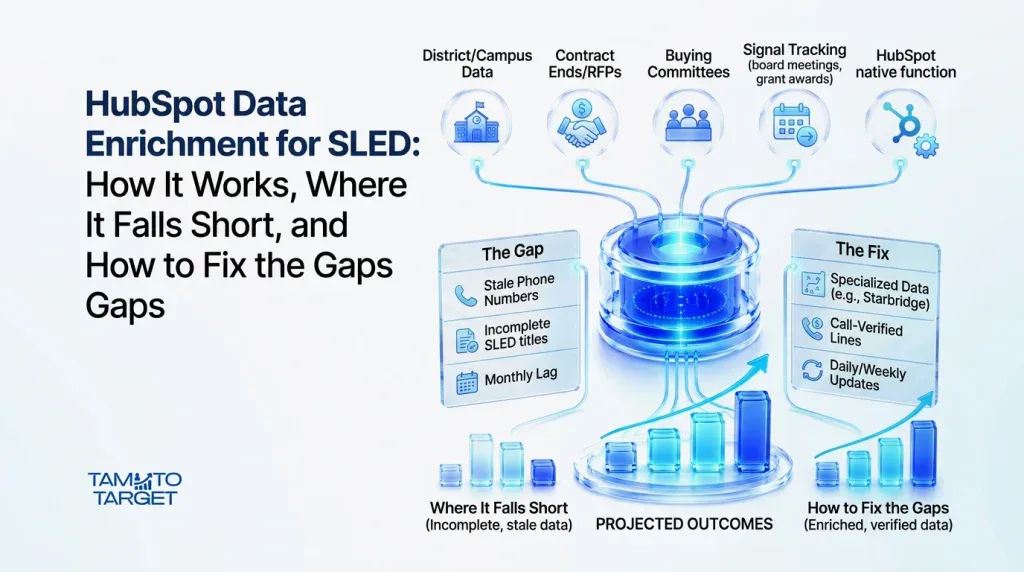
HubSpot Data Enrichment for SLED: How It Works, Where It Falls Short, and How to Fix the Gaps
Most HubSpot records start thin. A form fill gives you a name and an email, and maybe a job title if you asked for one. HubSpot data enrichment fills in the rest, so your team isn’t guessing who they’re talking to. Thin records are common. In July 2026, Validity surveyed 500 B2B and B2C marketing […]
Read Article

10 min read
What Is B2G Sales? A Beginner’s Guide to Business to Government Sales
If your team sells to schools, cities, or state agencies, you’re already doing B2G sales, even if nobody calls it that. Business to government sales follows its own rules, calendars, and buying habits. This guide covers what B2G means, how it differs from B2B and B2C, and how public agencies actually buy. You’ll also learn […]
Read Article
Ready to build pipeline in the gov + edu market?
Book a call and we'll show you exactly how we get your motion live and generating qualified meetings.
Book a Call